
This service is currently not available. Please try again later.
08/19/2026
Cruising | Aboard
Dry Stack Storage: A Smarter Way To Spend More Time On The Water
For most boat owners, the best part of ownership is fairly simple: being out on the water. The reality for many is that finding enough time to get afloat can be the biggest challenge.
Finding time between work and family commitments, preparing the boat, launching, cleaning down afterwards and keeping on top of maintenance can all eat into the hours owners actually have available to enjoy their boat.
And with the overall cost of ownership under greater scrutiny too, it is understandable that more people are looking at how they keep and use their boats and asking whether there is an easier way.
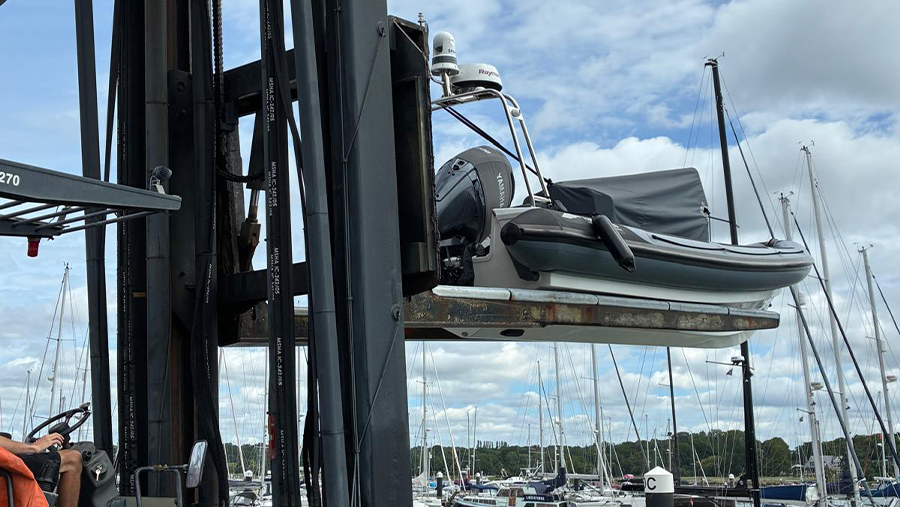
For RIB and smaller motorboat owners in particular, dry stack storage can provide one answer. Rather than leaving the boat permanently afloat or keeping it on a trailer, the boat is stored ashore in a purpose-built racking system and launched when the owner wants to use it.
The principle is simple, but the benefits extend considerably further than convenience alone.
Making limited boating time count
When time on the water is precious, making boating as straightforward as possible really matters. A free Saturday and a good forecast can suddenly become the perfect chance to head out, so the fewer obstacles between arriving at the marina and getting underway, the better.
This is where dry stacking comes into its own.
At many facilities, owners simply arrange for their boat to be launched and it will be waiting on the pontoon when they arrive. There is no trailer to manoeuvre, slipway to negotiate or tender journey out to a mooring.
The same flexibility can apply at the end of the day. Depending on the operator and the package chosen, owners may be able to return the boat to a designated pontoon and leave the dry stack team to lift it, rinse the hull, remove drainage bungs where appropriate and return it safely to its rack.
For owners who prefer to look after those jobs themselves, many facilities also provide maintenance racks where they can wash the boat, flush the engine and spend time checking equipment before it is stored.
It means convenience does not necessarily mean giving up involvement with your boat. Owners can choose the level of hands-on care that suits them. That flexibility can make a significant difference to how often a boat actually gets used. When going boating feels straightforward, spontaneous days on the water become much easier.
Why dry stacking works particularly well for RIBs
RIBs are especially well suited to this type of storage. Their relatively lightweight, practical hull design and lack of extensive accommodation mean many can be lifted and stored efficiently, while being ashore brings several additional advantages.
Security is one. A lightweight RIB stored afloat can potentially be more vulnerable to theft than a larger yacht or motorboat. Electronics and equipment can also be relatively exposed, particularly on open RIBs without cabins or secure below-deck storage.
A boat stored within a managed dry stack facility benefits from the site's wider security arrangements, which will often include controlled access and CCTV. The simple fact that the boat may also be sitting several metres above the ground introduces another physical barrier.
There are maintenance benefits too. A boat that spends most of its life out of the water is not permanently exposed to saltwater and marine growth. Provided it is not kept afloat for extended periods, an owner may also find that antifouling is unnecessary. That can mean less maintenance, lower ongoing expense and a cleaner hull. A clean hull also creates less drag through the water, potentially improving fuel efficiency compared with a hull affected by fouling.
For owners looking at both running costs and their impact on the marine environment, those are worthwhile considerations.
Less time in saltwater, less opportunity for deterioration
Anyone who owns a boat knows how relentless the marine environment can be. Saltwater, marine growth and prolonged exposure continually work on hulls, fittings and machinery.
Removing a boat from that environment whenever it is not being used can help reduce some of that pressure. It does not remove the need for proper maintenance and regular inspections, but it can help preserve the condition of the boat.
That may become important when the time eventually comes to sell too.A well-maintained RIB that has spent much of its life stored ashore may show fewer of the signs associated with continuous immersion, potentially helping its presentation and residual value.
As with any aspect of boat ownership, good storage is ultimately part of looking after the asset you already have.
Is my boat suitable for a dry stack?
One misconception is that dry stacking is only suitable for small, straightforward RIBs. In reality, suitability can depend on several factors.
Owners sometimes assume that a tall A-frame, radar arch or other equipment automatically rules their boat out. Often this is something worth discussing directly with the dry stack team. Taller vessels may be accommodated on an upper rack or, depending on the facility, in an alternative ground-level position.
Hull fittings and transducers are another common concern. Dry stack bunks can usually be adjusted so that the hull is supported appropriately while avoiding vulnerable fittings beneath the boat.
Perhaps more surprisingly, overall length is not always the deciding factor.Weight and, importantly, where that weight is distributed can be more significant. A longer boat with much of its weight concentrated aft around twin outboards may potentially be easier for the lifting equipment to handle than a shorter boat with a substantial forward cabin and greater weight towards the bow.
Every facility will have its own operational limits, so the best approach is always to speak to the operator about the individual boat rather than assuming it will or will not fit.
What about the racks themselves?
Seeing several boats stacked vertically for the first time can understandably prompt questions about stability, particularly during strong winds.
Modern dry stack systems are specifically engineered for this purpose and professionally installed facilities are designed to cope with demanding conditions. Many of the systems and principles used in the UK originated in the United States, where dry stack storage is well established in regions accustomed to considerably more severe weather. As with any marina infrastructure, professional installation, inspection and ongoing maintenance are important.
For owners, one much simpler consideration during periods of high winds is the boat's cover. A correctly fitted, properly secured cover is far less likely to become damaged or work loose while the boat is stored.
Flexibility beyond a single day's boating
Dry stacking does not mean the boat has to return to its rack every evening. For owners planning several consecutive days on the water, many operators can allocate a temporary marina berth.
Early starts can usually be accommodated too. If an owner wants to leave before the dry stack team begins operating in the morning, the boat can often be launched the previous evening and left ready on the pontoon.
Likewise, an enjoyable day does not necessarily need to be cut short simply to meet a lifting deadline. Some facilities allow owners returning later in the evening to leave their boat on a designated berth for recovery the following morning.
Around busy boating areas such as the Solent, that degree of flexibility is particularly useful. Pantaenius keeps its own RIB at MDL Hamble Point Marina, close to the mouth of the River Hamble. For us, the attraction is straightforward: quick access into Southampton Water, the Solent and further afield, while remaining close to many of the marine businesses, brokers and dealers we work with.
It means the boat is genuinely easy to use when we need it. That is arguably the greatest measure of whether any storage arrangement is working well.
Could dry stack become a bigger part of UK boating?
There are practical reasons why dry stacking is attractive to marina operators as well as boat owners. Instead of spreading boats horizontally across individual berths, vessels can be stored vertically within a much smaller footprint.
That does not mean dry stacks can simply be installed anywhere. They require considerable investment, suitable ground for heavy lifting machinery, appropriate waterside access and, in some locations, engineering work to support launching operations.
Where the right infrastructure is in place, dry stacking offers a simple way to make ownership easier. Keeping a boat ashore can reduce maintenance, limit marine growth and lessen the need for antifouling, while also making it quicker and more convenient to get out on the water. However, being stored ashore does not remove every risk, so appropriate insurance remains an important part of protecting your boat.
Ultimately, the real appeal is that boats are there to be used - and if the way they are stored makes it easier to head out for an evening, a weekend or a few spontaneous hours afloat - owners are far more likely to make the most of them.


